On "Rooms by the Sea" by Edward Hopper
|
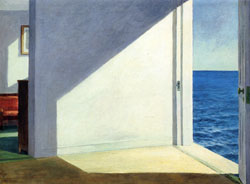
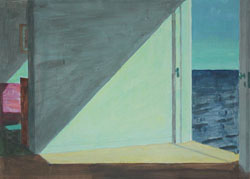
This picture is a paining" Rooms by the Sea"
by Edward Hopper. It is a oil painting and done on canvas in the year
1951. It´s size is about 75 x 100cm. Of course strictly speaking
it is just its copy. Edward Hopper was born in New York in the year 1982 and he died in the year 1967. He was almost the same age of Paul Klee, Pablo Picasso and Marsel Duchamp. He studied in New York Art School, when he was young. He sold his painting first time, when he was thirty years old, and he sold next painting 12 years later, when he was 42 years old. In the same year he quit other job and started to live as a painter. His water color paintings were sold somehow. After this time he began to become famous gradually. When I noticed he had been an unknown artist, I felt," It is interesting. He was as unknown as me at least until my age." However I still didn´t know what I should see in the picture. I started to check the composition of forms and colors. At same time I felt I was doing something wrong. I wanted to see something else. The picture looks strange, unrealistic. It looks like a picture by a surrealist artist. It was my first impression. I thought" Probably I should start to look into it with this point. Why does this picture look unrealistic? Why do I feel strange in this?" SEA
OUT SIDE OF A DOOR EMPTY
ROOM ROOM OUT OF PERSPECTIVE There
is something wrong in the shape of the room. I examined the line perspective
of the room and searched the vanish point of it. I found the perspective
of this picture is very wrong. How about is it in other pictures?
I checked up many pictures. WRONG
SHADOW Questions rise: Did he know what he did with the shadow? Did he done this on purpose? And why? Again
I started to check up his paintings. This time I checked only shadows.
It looks like so he painted shadows carelessly in many pictures. But
in a picture I found a woman seated down on a bench in a train. Light
come through windows. The shadow of the bench is on a floor but the
shadow of the woman is not there.
By Goro Shintami 1996 |
"Rooms by the Sea" by Edward Hopper
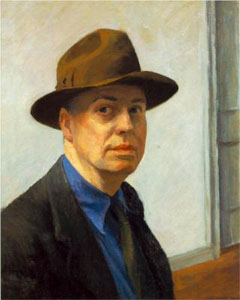
Self portrait of Edward Hopper
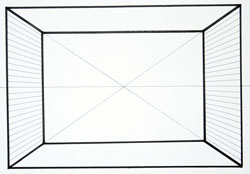
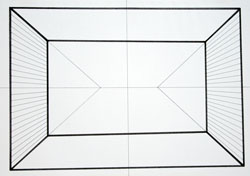
Common line perspective The center in this picture is vanishing point.
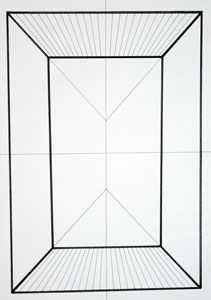
Hopper´s perspective: Roof has higher vanishing point than floor has.
Right side of room has the vanishing point in the more right side. And the leht side of room has it in the more left side.
The perspective and the shadow are corrected |
Edward Hopperin "Huoneita merenrannalla"
On the painting "Rooms by the Sea" by Edward Hopper - suomeksi 1996
|
KATSON
KUVAA
Kuva on Edward Hopperin maalaus "Huoneita meren rannalla",
se on öljymaalaus ja tehty kankaalle vuonna 1951, sen koko on
n.74x102cm. Tarkasti sanottuna tämä on sen painokuvasta
otettu värikopio. Edward Hopper on syntynyt New Yorkissa v.1882 ja kuoli v.1967. Hän oli melkein saman ikäinen kuin Paul Klee, Pablo Picasso ja Marsel Duchamp. Hän opiskeli New Yorkin taide koulussa nuorena. Hänen maalaus tuli myydyksi ensimmäiseksi 30 vuotinana, toinen maalaus tuli myydyksi vasta kun hän oli 42vuotias. Samana vuonna hän lopetti muita hommia ja aloitti elämään taidemaalarina - vesi-värimaalaukset ovat tulleet kaupaksi. Sen jälkeen hän tuli kuuluisammaksi vähitellen.
Huomasin, että hän oli melkein tuntematon taiteilija nuorempana.
Minun ikäisenä häntä ei tunnettu yhtään
paitsi lähipiirissä. Se kiinnosti minua. "Hän
oli yhtä tuntematon kuin minä. Hän voi olla hyvä
taiteilija," aloitin miettimään. MERI
OVEN ULKOPUOLELLA TYHJÄ
HUONE Ja sattumalta luin hänen sanoneen,"The interior itself was my main interest - simply a piece of New York, the city interests me so mach." vaikka hän ei tarkoittanut tästä maalauksesta, vaan toisesta, minua vahvisti se, että olen oikeassa.
Tyhjä huone sinänsä ei ole kumma. Kun me menemme töihin,
asuntomme jää tyhjiin. Se on arkielämässä.
Mutta emme käy tyhjää näyttämöä
katsomassa, vaan menemme katsomaan esitystä. Tässäkin
haluamme katsoa esityksen. Mutta hän näytti vain tyhjää
näyttämöä. Tulos
oli: Hänellä
oli tietty väärinkäyttö menetelmä: Tässä
kuvassa tapahtuu seuraavalla tavalla: Onko
Hopper tehnyt tätä tarkoituksella? VÄÄRÄ
VARJO Tuli
kysymys:
Taas aloitin tutkimaan varjoja hänen maalauksissa. Näytti
siltä, että hän maalasi varjoja huolimattomasti. Eräässä
maalauksessa nainen istuu junan penkillä ja valo tulee ikkunasta.
Penkillä on varjo mutta naisella ei.
Halusiko hän koettaa katsojaa, huomaako katsoja virhettä
tässä kuvassa? Huomaako kriitikot virhettä? MITÄ
TAITEEN YMMÄRTÄMINEN ON? Mitä
katsotaan taiteessa?
|
"Rooms by the Sea" by Edward Hopper
Self portrait of Edward Hopper
Common line perspective The center in this picture is vanishing point.
Hopper´s perspective: Roof has higher vanishing point than floor has.
Right side of room has the vanishing point in the more right side. And the leht side of room has it in the more left side.
The perspective and the shadow are corrected |